Newly retired and searching for answers, ROSIE TANNER set off on a 550-kilometre pilgrimage along Italy’s Way of Saint Francis. Here, she describes how she turned six weeks on the trail into her debut travel article.
At 67, after a fruitful career as a teacher educator, I found it surprisingly easy to leave work behind me. But as a recent retiree, one question kept me awake at night: what do I actually want now?
The answer, I suspected, lived somewhere on a long trail – on a pilgrimage. So I booked a flight to Florence, laced up my hiking boots and set off alone on the Way of Saint Francis.
I hadn’t planned on writing about my journey, but somewhere in Umbria, on a misty afternoon in the woods between Assisi and Spoleto, the idea dawned on me. I was mentally composing sentences as I walked – describing the way the light fell in beams through the beech woods, trying to find the exact word for the colour of the red village roofs: burgundy? Russet? Terracotta?
Suddenly, this felt like writing for someone, and I found my childhood dream of becoming a travel writer re-emerging.
Learning the rules before I could break them
I decided that if I was going to do this properly, I had to treat it like a project. I filled my pilgrim evenings with detailed descriptions of the trail and the other pilgrims I met, as well as facts I learned about Saint Francis along the way.
When I got home, I enrolled in an online travel writing course with UK Writers’ College and chose my target publication: The Great Outdoors (TGO), a British magazine for people who love nature and adventure. That was me, surely – a woman who had just walked solo through Italy.
I spent weeks doing what my tutor called ‘market analysis’ and what I called reading magazines on my iPad in the bath. A vital part of the course involved analysing the structure, length, content and rhythm of travel articles. I pored over dozens of TGO features, studying the way they balanced practical information with personal narrative.
When I finally started writing my piece, I stuck to the publication’s author guidelines religiously, even when it meant cutting anecdotes that I loved. I had to accept that the story I wanted to tell was different from the one TGO’s readers needed and its editor would accept.
That tension between writing for a publication and staying true to my own voice turned out to be the hardest part of the whole process. Harder than the steep hills. Harder, even, than the blistering June heatwave that had made every afternoon on the trail feel like walking through a furnace.
Killing my darlings
At one point during the course, my Writers’ College tutor, multi-award-winning veteran travel writer Donna Dailey, emailed me with a warning: ‘You are about to become an axe murderer.’
She meant killing my darlings, of course. Every writer has them – the passages we love so dearly we can’t see that they’re strangling our writing. In my early drafts, I had tried to cram all six weeks of the pilgrimage into a single feature, which resulted in what Donna rightly described as ‘a catalogue of tedious facts’.
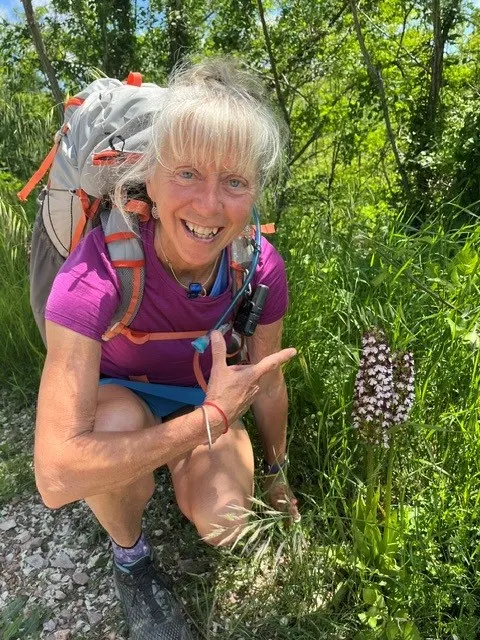
Among them were my lyrical description of the nine unusual orchids I had spotted in the Apennines, and my favourite paragraph about a handsome chapel custodian with warm brown eyes and a trendy ponytail, who showed me round his chapel home and shared an espresso. Every village, every climb, every pilgrim got a mention, so my piece read more like an earnest diary entry than a magazine article. Donna made me cut them all.
One fix, when it finally came to me, was to create a separate fact file – distances, accommodation tips, best seasons – and release it into a sidebar.
My article now had a clear focus: inspiring other older women to go on a solo pilgrimage. The chapel caretaker and the orchids crept back into my journal, where they belong. They might resurface in another article, another day.

Finding a hook for my article
Finding the right opening was another challenge. It took me a full, agonising month, and I discarded three other candidates before settling on an encounter that had taken place halfway through my 550-kilometre pilgrimage.
I had been walking through the beech woods just after sunrise when about twenty silhouettes charged across my path: six females, a troop of tiny striped bodies and, bringing up the rear, a huge male. I glimpsed the curve of his tusks. One thing was undeniable: these were wild boars. I froze, my hiking poles useless in my trembling hands, and watched the family thunder past. Then I did what any sensible writer would do: I pulled out my notebook and started scribbling what was to become my article opener.
Daring to ask for help
Somewhere around the fourth draft of my travel article, I started to lose all perspective on whether the piece was any good at all.
I couldn’t help comparing my drafts to polished travel features and feeling hopeless. Who was I, as a fledgling travel writer in her sixties, to break into print? Imposter syndrome followed me through every draft.
I roped in my partner, Roel, and my friend Jenny, who reads voraciously and usually gives useful feedback. But they didn’t really hit the mark.
On a whim, I fed my draft to Claude, an AI assistant, with the prompt, ‘You are the editor of The Great Outdoors magazine. Give me feedback so you’d accept my article.’ Claude was quite skilful – it suggested rejigging the content and making my ending more dynamic. I stayed critical, cross-referencing Claude’s suggestions with Donna’s guidance and my own instincts. But it was a useful mirror.
I still rewrote the piece twice more after that.
Coming up for air
The morning I emailed TGO’s editor with my piece, I felt like I was plunging into one of those icy Italian rivers: certain, for a moment, that I had made a terrible mistake.
He didn’t say no to the piece.
He said publication was ‘possibly a year away’ and asked to see photographs. I sent 30, hoping he might love them as much as I did. Now I’m waiting – for his response on the images, for a confirmed slot in the schedule, for the day I might see my name in print as a travel journalist for the first time at the age of 68.
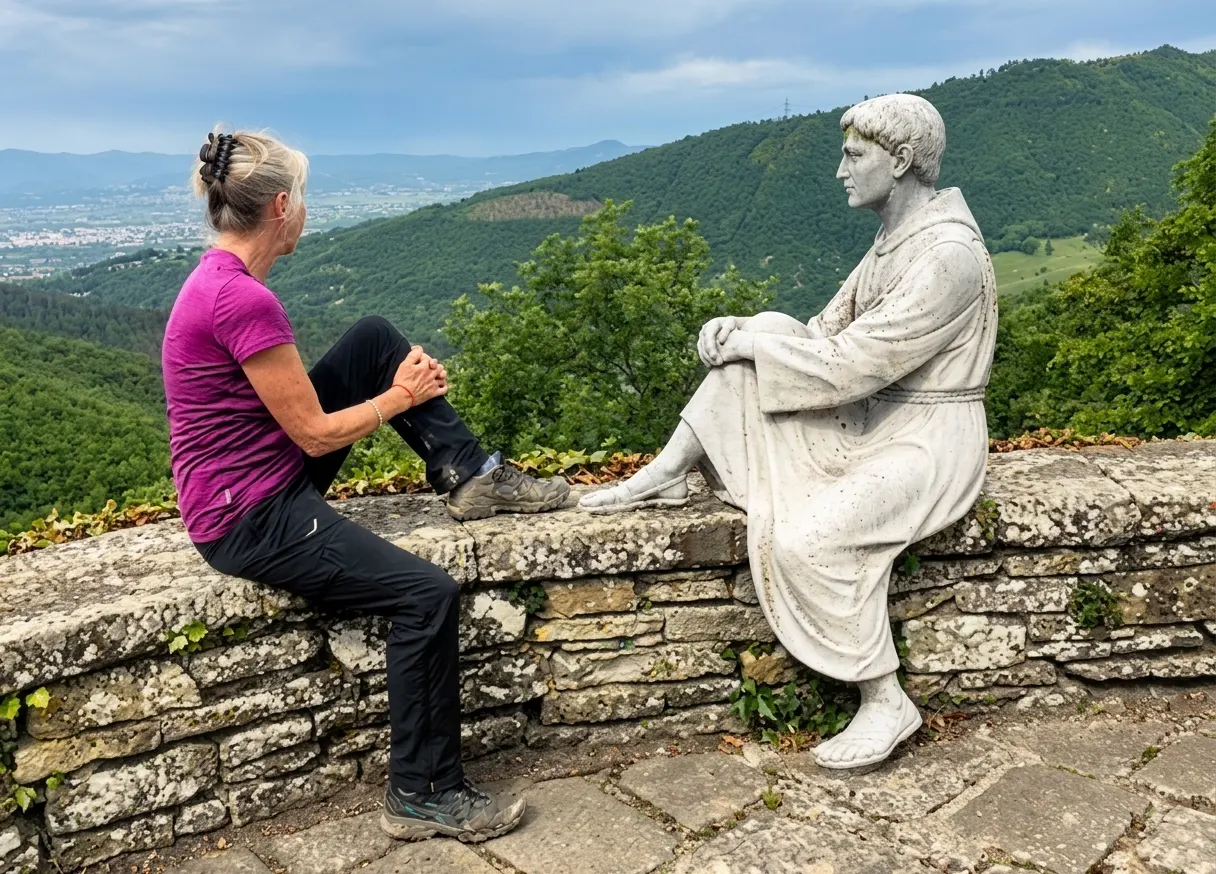
In the meantime, I’ve gone back to the question that started all of this: what do I want in my retirement? The answer had come while I was sitting on a wall next to a statue of Saint Francis overlooking the Tiber River valley, my feet aching and my heart full: more of this. Another pilgrimage. Another six weeks of walking solo into whatever comes next.
Now, as I search for my next route on my iPad – perhaps the Camino di San Benedetto, which threads through the mountains of Lazio – I find myself, almost without deciding to, opening a new document that might just become another travel piece.
About the Author
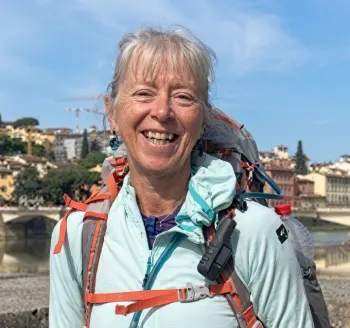
Rosie Tanner is a British travel writer focusing on slow solo female travel after retirement. She lives in the Netherlands and has two adult children. Recent hikes have included another solo pilgrimage – along the Way of Saint Benedict in Italy – and the tough Peaks of the Balkans trail through Albania, Montenegro and Kosovo with a woman friend. Rosie has lived and travelled from Chile to China, from South Africa to Norway. When at home, she sings, plays the ukulele and padel and tries to keep fit. She travels a lot around Europe in her camper, called Ruth after her favourite aunt who left her a surprise inheritance. She hopes to hike and camp well into her seventies, if not beyond, and to continue writing about long-distance trails.